Home & Comfort · Research Article
How to Choose the Right Pillow Height
Loft is the specification most often ignored and the one most likely to make a well-reviewed pillow feel wrong for you.

Quick Takeaway
Pillow height, or loft, is the thickness of the pillow under load. The right loft is the one that fills the gap between your head and the mattress in your usual sleeping position without tilting your head up or letting it drop.
Loft is not a fixed personal number. It changes with your shoulder width, how soft your mattress is, how firm the pillow is, and which position you spend the night in — which is why a pillow that works for one person can feel wrong to someone else in the same bed.
Most pillow disappointment is a height problem rather than a quality problem. A well-made pillow at the wrong loft will feel like a bad pillow, and no amount of material quality fixes it, because the mismatch is geometric.
This article explains what loft means, how it is measured, what changes it, and how to read the signs that the pillow you already own is too high or too low.
What Pillow Loft Means and How Height Is Measured
Loft is simply the height of the pillow from the surface it rests on to its top. Sellers usually quote it uncompressed, measured on a flat surface with nothing on the pillow — which is not the height you actually sleep on, because a head compresses a soft pillow considerably more than a firm one.
Rough conventions place low loft under about 8 cm (3 in), medium loft between about 8 and 12 cm (3 to 5 in), and high loft above roughly 12 cm (5 in). These bands are not standardised and different sellers draw them differently, so treat them as orientation rather than as a specification you can compare across brands.
- Low loft: under roughly 8 cm / 3 in.
- Medium loft: roughly 8-12 cm / 3-5 in.
- High loft: above roughly 12 cm / 5 in.
- Contoured pillows usually quote two figures — the higher and lower contour edges.
Shoulder Width Sets the Pillow Height You Need

The practical purpose of a pillow is to fill the space between your head and the mattress so your head is supported in line with the rest of you, rather than propped up or hanging down.
On your side, that space is roughly the width of your shoulder, so broader shoulders generally need more loft. On your back, the gap is much smaller — the back of your head already rests close to the mattress — so a lower loft is usually needed for the same person. Face down, the gap is smaller still, which is why very thin pillows, or none at all, suit that position.
How Your Mattress Changes the Right Pillow Height
Loft only makes sense relative to the surface underneath it. A soft mattress lets your shoulder sink in, which closes part of the gap and means you need less pillow height than the same body would on a firm surface. A firm mattress holds your shoulder up, leaving a larger gap and calling for more loft.
This is the most common reason a pillow recommended by a friend or a review feels wrong: the advice was accurate for the bed it was tested on. If you change mattresses, expect your pillow preference to change with it.
How Pillow Firmness Interacts With Loft
Two pillows quoted at the same height can sleep at different heights. A soft pillow compresses under the weight of your head, so its effective loft during the night is lower than the figure on the box. A firm pillow compresses less and sleeps close to its stated height.
The practical consequence: if you are choosing a soft pillow, a slightly higher stated loft often ends up about right, while a firm pillow at the same stated loft may feel too tall.
Signs Your Pillow Is Too High or Too Low
You do not need any equipment to assess this. The clearest evidence comes from how you sleep and what you do with the pillow during the night.
- Too high: your chin is pushed toward your chest, or you wake with a stiff, tight feeling along the side of the neck.
- Too low: your head tips back, or you find yourself folding the pillow in half or sliding a hand or arm underneath it.
- About right: your head, neck and spine form a relatively straight line when someone looks at you from behind, and you are not constantly repositioning.
- Position-dependent: if it is right on your back but wrong on your side, you may be a combination sleeper who needs a contoured or adjustable pillow.
Adjustable Loft Pillows: When They Help
If you change position during the night, no single fixed loft is right for all of it. Two designs address this. Shredded-fill pillows with a zip let you remove or add fill until the height suits you, which is the most direct solution when you do not know your number in advance. Contoured pillows offer two different heights along the pillow, letting you turn it to a taller or shorter edge.
Both approaches involve compromise, and neither is universally better. What matters more is that the pillow can be adjusted or returned, because loft is genuinely difficult to judge from a product page.
How to Check Pillow Height Before Ordering
Loft is the specification most worth pinning down before you pay, and the one most worth protecting with a return policy afterwards.
- Find your usual position, or acknowledge that you change during the night.
- Note whether your mattress is soft or firm.
- Look for the loft figure in centimetres or inches, not just a word like "medium".
- For contoured pillows, find both contour heights.
- Prefer adjustable fill if you are unsure of your number.
- Check the return window before ordering — loft is often only testable in use.
Getting Pillow Height Right
Take this with you to any product page, in this category or another.
- Identify your usual sleeping position
- Account for shoulder width on your side
- Factor in how soft your mattress is
- Find the stated loft in centimetres or inches
- Check both heights on a contoured pillow
- Consider adjustable fill if unsure
- Confirm the return window before ordering
Frequently Asked Questions
Continue Reading
Home & Comfort · Updated September 2026
Best Ergonomic Pillows: What Should You Look For?
We break down the key factors worth comparing before choosing an ergonomic pillow — including shape, materials, sleeping position, support and overall value.

11 min read
Read Guide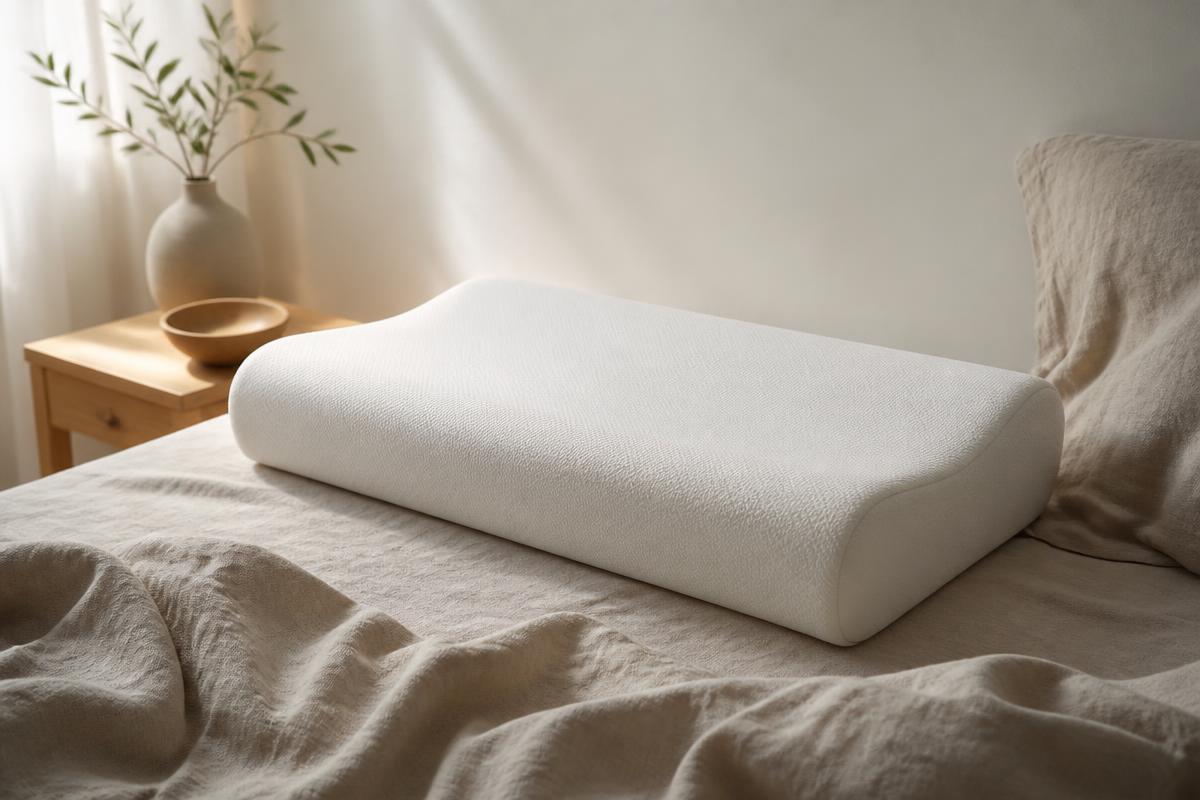
Home & Comfort · Updated September 2026
Memory Foam Pillows: What to Know Before Buying
Foam pillows are described in broadly similar language but behave very differently in practice. Here is what the specifications actually tell you.
8 min read
Read ArticleHome & Comfort · Updated September 2026
Pillows for Side, Back and Stomach Sleepers: What to Compare
Position is the first filter in any pillow decision — it changes the loft, the firmness and often the shape you should be shortlisting.
8 min read
Read ArticleAbout Clever Cart Guide
Clever Cart Guide creates independent buying guides designed to help consumers compare products, understand product features and make more informed purchasing decisions. We are not the manufacturer or seller of any product mentioned on this page.